
Strasbourg
Texte original en anglais, non traduit.
Check against delivery
Opening and closing remarks by Mr Alain Berset, Secretary General of the Council of Europe
Good afternoon, everyone, here in the Hemicycle and online. And welcome to the Council of Europe.
Churchill can still draw a crowd, even with protests in Strasbourg today.
Thank you for joining us. And thank you to our guests: Minister Chris Elmore; Shadow Minister Alicia Kearns, with us from London; and Rupert Soamesfrom the Home Office.
Rupert, I’m about to speak about your grandfather’s legacy. If I get anything wrong… just cough.
***
Eighty years ago, a giant of British politics, who had won the war but lost an election, travelled to Switzerland to rest and paint. Oh, and he even found time for a speech.
There, at the University of Zurich, Winston Churchill told France and Germany to become partners. Barely a year after the war.
He called on Europe to arise.
And he said Britain would support Europe from a distance. From a safe distance.
[PAUSE]
Try getting away with any of that today.
***
Churchill also told us where to begin.
Let’s listen to him.
[AUDIO CLIP PLAYS: 18 sec. Churchill, Zurich 1946. Ends on “…a Council of Europe.”]
***
Less than three years later, ten countries, including the United Kingdom, signed the Statute of the Council of Europe in London.
Few people still read it. They should. It was written for times of rupture. Very much like now.
The Statute begins with peace. And not any peace. A peace built on justice.
In Zurich, Churchill said the same: the guilty must answer for their crimes. Twelve days later, at Nuremberg, they did.
David Maxwell Fyfe, one of Churchill’s former ministers, cross-examined Göring. He went on to help write the European Convention on Human Rights.
***
The Convention was written to make sure Europe would never need another Nuremberg.
And yet, here we are.
Russia’s crimes in Ukraine cannot go unpunished. The Council of Europe has created accountability where there was none. A just peace depends on it.
***
This is where Churchill speaks to a generation born long after him.
Most people remember that the Zurich speech ends with “Let Europe arise!”
Few remember how it begins.
It begins with hungry and tormented people. And with what peace owes them: the simple joys and hopes that make life worth living. The Statute calls it economic and social progress.
Is that what many young people are asking for across Europe today?
If it is, they are not turning against Europe. They are children of Churchill too.
***
A legacy that speaks to so many will be claimed by many.
Today, Churchill is claimed by both sides in Europe’s most fundamental debates, some of them about this Organisation itself.
But we can all agree on one thing. He saw the Council of Europe as a political instrument to keep the peace and defend democracy.
[LOOK AT CHURCHILL’S GRANDSON]
Rupert? No cough. Good.
***
Keep the peace and defend democracy. Churchill tried to do just that here in 1950, when he proposed a unified European army under democratic control.
He was right about democratic control. He still is. At a time of rearmament and weakening democracies, our objective remains to rearm Europe without disarming democracy.
That army never happened. From the start, the Statute kept defence outside the Council of Europe.
Never security.
Putting democracy, human rights and the rule of law at the heart of Europe’s security architecture has been this Organisation’s work ever since. Lasting security in Europe depends on it.
***
That architecture is a common legal space, shared by the forty-six Council of Europe member states, the United Kingdom among them.
One space. One Convention. One Court.
And many possibilities for peace. Like the Good Friday Agreement, when two sides that did not trust each other chose to trust the same rights.
Isn’t that exactly what Churchill had in mind?
***
The Council of Europe he called for in Zurich is not perfect. Neither was he.
Churchill was a wartime leader. A force of nature. A British and European icon.
Above all, he was a visionary.
He saw a Europe that didn’t exist yet, where law would replace force. And the organisation it would need when that law stops being self-evident, even to those who wrote it.
Churchill did his part. The rest was always going to be ours.
***
I wanted to take a moment to thank you all for coming together today to reflect on Churchill’s legacy and Europe’s future.
It’s rare and it is so meaningful to do it right here, with all of you.
So thank you to Minister Elmore, to Rupert, to Alicia Kearns, who was with us from London, and to Anand, for steering this conversation.
And thank you to all of you for showing that bold ideas never die.
And that they can be debated here, openly and frankly. That is how it should be.
***
Today, we have heard who Churchill was, what he left us, when he built it, and where it has brought Europe.
Let me add the WHY.
Why him. Why here. Why now.
***
I believe it is because we no longer recognise the world Churchill left us. That world order is gone.
A new one is emerging, and we are concerned that Europe will have no say in it.
And we should be.
On Thursday, in Shenzhen, three men will sit down together.
The President of the United States. The President of China. And the President of Russia, a country expelled from this Organisation for invading its neighbour.
They will discuss Ukraine’s future. And with it, Europe’s security. Without a single European in the room.
***
Eighty-one years ago, three men also sat down to decide the future of Europe. At Yalta.
With one major difference. One of them was Winston Churchill.
The Blitz. A continent in ruins. Millions dead. Millions more on the roads with nowhere to go. And the camps.
Churchill knew what happens when force takes the place of law.
So do we. That is why we are here today.
To honour his legacy. To follow his example. And to shape our own destiny.
***
Churchill had every reason to despair. But that was not who he was. He fought on and left us a message for times like these:
“Never give in. Never give in. Never, never, never, never.”
Thank you.
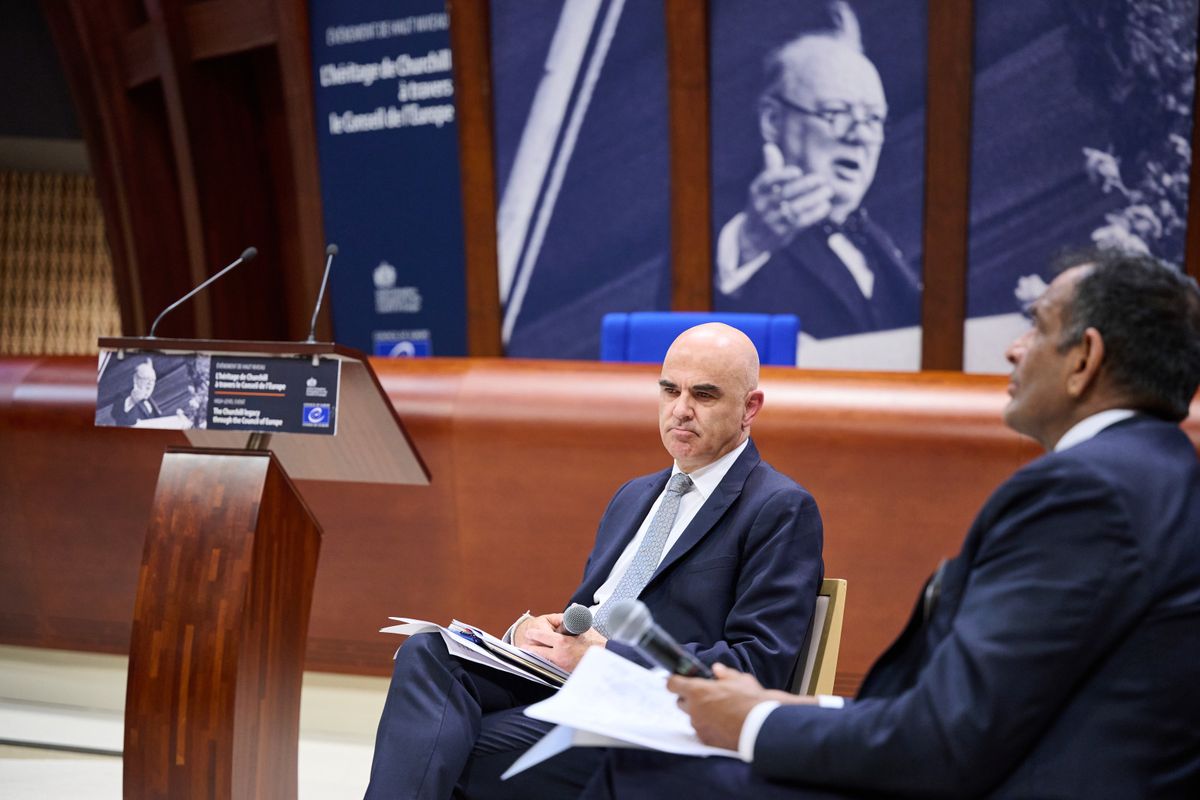
© Council of Europe — High-level commemorative event “The Churchill legacy through the Council of Europe”